SPLENDID PLAYGROUND (after Gutai)
Ei Arakawa-Nash, Ei Arakawa-Nash / Nikolas Gambaroff, Nora Schultz
Main gallery
Mar 20th 2026 – May 16th 2026







Exhibition Text
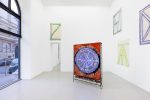
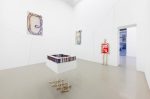
The occasion for the exhibition SPLENDID PLAYGROUND1 is the nomination of Ei Arakawa-Nash as Japan’s representative at the 2026 Venice Biennale and his associated design of the Japanese Pavilion. This provides a valid reason to look back at some aspects of his sculptural work in the context of his frequent collaborators, Nora Schultz and Nikolas Gambaroff.
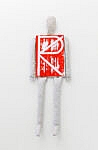
In their collaboration, which began in 2008, Ei Arakawa-Nash and Nikolas Gambaroff have regularly developed various reinterpretations of so-called Two-Alphabet Monograms. Originally created in 2009 as a dysfunctional written and spoken language, the project remains in constant development, finding various formal and material forms of existence in performances, installations, objects, and lectures:
One will pat the 25 randomly drawn cards on four different parts of one’s body: Head, Heart, Gut, and Below. The result is your Two-Alphabet Monogram self-portrait, that is Bodycard Testimonial. With this testimonial being voiced out in different abstract modes, one can consult the cards of and on your past, present and future: any questions and concerns. Two-Alphabet Monograms are tools to ST IR UP AN IN TE RS UB JE CT IV EP OE TR YO CE AN.
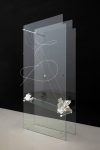
The working methods and artistic approach of Ei Arakawa-Nash, Nikolas Gambaroff, and Nora Schultz are characterized by a number of similar features: they all explore the production and meaning possibilities of traditional artistic media such as painting, sculpture, plastic arts, photography, reproduction and printing processes, and installation. This is exemplified in the collaborative performance Social Scarecrows Printing Fields by Arakawa-Nash and Schultz together with Henning Bohl at the Reena Spaulings Fine Art Gallery in New York in 2012. The artists demarcated a large performance area in the middle of the gallery using a transparent plastic sheet laid out on the floor. Arakawa-Nash, Schultz, and Bohl poured large cans of black and white paint into a metal basin on the side and mixed the colors to create prints. The audience was spread throughout the room, but for the most part they began and ended their visit on the side from which they had entered. Several times, Arakawa-Nash broke through the supposed fourth wall and asked the audience to make room for him. As a result, the audience assumed various constellations throughout the performance, making it impossible to establish a single, definitive point of view. Starting with an open idea of printing, Arakawa-Nash and Schultz activate a series of bodily and mechanical gestures, sculptural objects, materials and images. Here, printing is considered as a way of engaging reality, of making contact with the world by inserting oneself into its spaces and economies. Both Arakawa-Nash and Schultz, as well as Gambaroff and Bohl, raise questions about process, institutional context, and performativity in their conscious use with their respective media. For example, in her 2012 exhibition Portikus Printing Plant and Portikus Sounds, Nora Schultz presented a live performance of a printmaking workshop, suggesting that the press itself should be understood as a sculptural link between people and the images they produce. The sculpture Bird Singing in the Reality Rain, 2012, reflects this approach. Schultz allows the process to speak for itself, often leaving the artworks in a reconstructable or modifiable heap. In the case of In Out Press, a work also composed of two sculptures, large rectangular panels set on hinges with the word “In” cut into one and the word “Out” cut into the other create large book-shaped printing presses producing prints with diametrically opposed meaning.
Michelle Cotton: The work employs a language that formally asserts the authority of a definitive, autonomous statement, only to undermine it. Elements will not be fixed, preferring to cancel each other out. The standard physical and conceptual frameworks for an exhibition appear corrupt by the work or an act of duplication. (…) Amongst this archaeology of systems in language and architecture there’s an idea of continuity, multiplication and renewal that quietly wins out over the schematic inevitability – Schultz teases out the possibility of accounting for a structure, its origins and effects and finding new ways to transform it.[2]
Ei Arakawa-Nash does not produce paintings himself and is therefore always dependent on the works of other artists, which leads to a kind of doubling of the artist within his work. It’s because I am constantly shifting toward another identity in my work. But I did a performance („Colgne of the Maghreb“) last year [2016] at Museum Ludwig which centered on the Cologne-based painter, Michael Buthe (1944-1994), who was part of the same generation as Sigmar Polke but is a little forgotten these days. He was obsessed with Morocco and had several Moroccan boyfriends. His works were also heavily influenced by Moroccan culture, so to some people he could be considered an Orientalist, whereas others could say that he showed a commitment that goes way beyond Orientalism. I felt there’s a conceptual relationship in his relationships with his Moroccan lovers, like he was literally able to internalize the culture of the other, so I made an installation with singing LED paintings speculating about that, although maybe the body politics was a bit obscured because of the LED installation. (…) Technology has always been part of art – think about Jikken Kobo, EAT, Fujiko Nakaya, Nam June Paik. But I think the situation with technology is going through another big transformation right now, so I want to focus on it or engage it through history. My friend Nikolas Gambaroff says that because of the Internet we are able to simultaneously access numerous historical references at the same instant. The use of history is really different under these conditions.[3]
Arakawa-Nash’s continued his strategy of questioning the performative potential of painting in Harsh Citation – Harsh Pastoral – Harsh Münster, Head of Installation, 2017, an audiovisual installation for the Skulptur Projekte Münster 2017 exhibition, as well as in the exhibition Performance People at the Kunstverein Düsseldorf in 2018. In both cases, Ei Arakawa-Nash expored the performative potential of LED paintings and proposed an alternative interpretation of performance art. The eight LED works presented at the Kunstverein Düsseldorf, for example, were then subjected to astrological analyses by the American artist Sarah Chow in relation to their respective times and places of births. In this way, performances such as Tony Conrad’s 7360 Sukiyaki (1973) and May I Help You? by Andrea Fraser (1991), or Lee Lozano’s Untitled (Boycott Women) from 1971 are literally addressed as “persons” in Arakawa-Nash’s multimedia LED works—including their respective psychological idiosyncrasies, their fateful destinies, and the power of their interpersonal desires. How do performances think and feel?
Ei Arakawa-Nash (*1977, lives in Los Angeles)
Nikolas Gambaroff (*1979, lives in Berlin)
Nora Schultz (*1975, lives in Vienna)
[1] Splendid Playground was the title of an exhibition of the same name by the Gutai art collective (founded in 1954 by Yoshihara Jirō) at the Guggenheim Museum in 2013.
[2] Cotton, Michelle, Conversations, in: Texte zur Kunst, No. 67, 2007
[3] Maerkle, Andrew, Ei Arakawa: Pt I and Pt II, in: ART iT, June 9 and 16, 2017
Ausstellungstext
Anlaß der Ausstellung SPLENDID PLAYGROUND1 ist die Berufung von Ei Arakawa-Nash zum Vertreter Japans auf der Biennale von Venedig 2026 und seiner damit verbundenen Gestaltung des Japanischen Pavillons. Grund genug, einen Rückblick auf einige Aspekte seines skulpturalen Schaffens im Kontext zu seinen oftmaligen Kooperationspartner:innen Nora Schultz und Nikolas Gambaroff zu werfen.
In ihrer Zusammenarbeit, die im Jahr 2008 begann, entwickelten Ei Arakawa-Nash und Nikolas Gambaroff in regelmäßigen Abständen verschiedene Umschreibungen von sogenannten Two-Alphabet Monograms. Ursprünglich im Jahr 2009 als eine dysfunktionale, geschriebene und gesprochene Sprache entstanden, bleibt das Projekt in ständiger Entwicklung und findet verschiedene formale und materielle Daseinsformen in Performances, Installationen, Objekten und Vorträgen:
Man legt die 25 zufällig gezogenen Karten auf vier verschiedene Körperstellen: Kopf, Herz, Bauch und Unterleib. Das Ergebnis ist Ihr Zwei-Alphabet-Monogramm-Selbstporträt, das sogenannte Bodycard-Testimonial. Indem man dieses Zeugnis in verschiedenen abstrakten Formen ausspricht, kann man die Karten zu Vergangenheit, Gegenwart und Zukunft befragen: zu allen Fragen und Anliegen. Zwei-Alphabet-Monogramme sind Werkzeuge für ST IR UP AN IN TE RS UB JE CT IV EP OE TR YO CE AN.
Die Arbeitsweise und künstlerische Haltung, sowohl von Ei Arakawa-Nash und Nikolas Gambaroff als auch von Nora Schultz, zeichnet sich durch eine Reihe von ähnlichen Merkmalen aus: Allen gemeinsam ist das Austesten von Produktions- und Bedeutungsmöglichkeiten traditioneller künstlerischer Medien wie Malerei, Skulptur, Plastik, Fotografie, Vervielfältigungs- und Druckverfahren und Installation. Etwa in der gemeinschaftlichen Performance Social Scarecrows Printing Fields von Arakawa-Nash und Schultz gemeinsam mit Henning Bohl in der Reena Spaulings Fine Art Gallery in New York im Jahre 2012. Die Künstler:innen grenzten mit einer durchsichtigen Plastikfolie, die auf dem Boden lag, eine große Performancefläche in der Mitte der Galerie ab. Arakawa-Nash, Schultz und Bohl schütteten große Dosen mit schwarzer und weißer Farbe in ein Metallbecken auf einer Seite und mischten die Farben, um Drucke anzufertigen. Die Zuschauer waren im gesamten Raum verteilt, begannen und beendeten jedoch ihren Besuch größtenteils auf der Seite, von der sie gekommen waren. Mehrmals durchbrach Arakawa-Nash die vermeintlich vierte Wand und bat die Zuschauer, ihm Platz zu machen. So nahm das Publikum im Verlauf der Performance verschiedene Konstellationen an, und auf diese Weise ließ sich auch kein eindeutiger Blickwinkel festlegen. Ausgehend von der offenen Idee des Druckens aktivierten Arakawa-Nash, Schultz und Bohl eine Reihe von körperlichen und mechanischen Gesten, skulpturalen Objekten, Materialien und Bildern. Hier wird Drucken als Mittel betrachtet, sich mit der Realität auseinanderzusetzen, mit ihr in Kontakt zu treten, indem man sich in ihre Räume und Wirtschaftssysteme einschreibt. Sowohl Arakawa-Nash und Schultz als auch Gambaroff und Bohl werfen im bewussten Umgang mit den jeweiligen Medien Fragen nach Prozess, institutionellem Kontext und Performativität auf. So präsentierte etwa Nora Schultz in ihrer Ausstellung Portikus Printing Plant and Portikus Sounds 2012, die Live-Performance einer Druckwerkstatt und legt damit nahe, die Presse selbst als skulpturales Bindeglied zwischen Menschen und den von ihnen erzeugten Bildern zu verstehen. Auch die Skulptur Bird Singing in the Reality Rain, 2012 reflektiert diese Vorgangsweise. Schultz lässt ein Verfahren für sich selbst sprechen, indem sie das Werk als rekonstruierbare oder modifizierbare Anhäufung belässt. In Out Press zum Beispiel bestand aus zwei Skulpturen aus großen rechtwinkeligen Platten auf Scharnieren. Aus einer Platte wurde das Wort „In“ ausgeschnitten, aus der anderen das Wort „Out“. So entstanden zwei große buchförmige Druckerpressen, mit denen Drucke gegensätzlicher Bedeutung hergestellt werden konnten.
Michelle Cotton: Das Werk bedient sich einer Sprache, die formal die Autorität einer endgültigen, autonomen Aussage behauptet, nur um diese dann zu untergraben. Elemente sind nicht fixiert, sondern heben sich gegenseitig auf. Die üblichen physischen und konzeptionellen Rahmenbedingungen einer Ausstellung erscheinen durch das Werk korrumpiert oder wie ein Akt der Duplikation. (…) Inmitten dieser Archäologie von Systemen in Sprache und Architektur triumphiert leise die Idee von Kontinuität, Vervielfältigung und Erneuerung über die schematische Unvermeidlichkeit – Schultz lotet die Möglichkeit aus, eine Struktur, ihre Ursprünge und Wirkungen zu erfassen und neue Wege ihrer Transformation zu finden.[2]
Ei Arakawa-Nash selbst fertigt keine Gemälde an und ist dadurch stets auf die Werke anderer Künstler:innen angewiesen, was zu einer Art Verdopplung des Künstlers innerhalb seiner Arbeit führt. Das liegt daran, dass ich in meiner Arbeit ständig in eine andere Identität schlüpfe. Letztes Jahr [2016] habe ich im Museum Ludwig eine Performance aufgeführt („Cologne of the Maghreb“), die sich um den Kölner Maler Michael Buthe (1944–1994) drehte. Er gehörte derselben Generation wie Sigmar Polke an, ist aber heute etwas in Vergessenheit geraten. Er war von Marokko fasziniert und hatte mehrere marokkanische Partner. Seine Werke waren stark von der marokkanischen Kultur beeinflusst, weshalb er von manchen als Orientalist angesehen werden könnte, während andere sagen würden, dass sein Engagement weit über den Orientalismus hinausging. Ich empfand eine konzeptuelle Verbindung in seinen Beziehungen zu seinen marokkanischen Liebhabern, so als ob er die Kultur des Anderen buchstäblich verinnerlichen konnte. Deshalb habe ich eine Installation mit singenden LED-Gemälden geschaffen, die darüber spekuliert – obwohl die Körperpolitik durch die LED-Installation vielleicht etwas verschleiert wurde. (…) Technologie war schon immer Teil der Kunst – man denke an Jikken Kobo, EAT, Fujiko Nakaya, Nam June Paik. Ich glaube aber, dass die Technologie gerade einen weiteren großen Wandel durchläuft, und deshalb möchte ich mich darauf konzentrieren oder sie im Kontext der Geschichte beleuchten. Mein Freund Nikolas Gambaroff sagt, dass wir dank des Internets gleichzeitig auf zahlreiche historische Referenzen zugreifen können. Der Umgang mit Geschichte ist unter diesen Bedingungen ein ganz anderer.[3]
Fortsetzung fand Arakawa-Nashs Strategie der Befragung der performativen Potenziale von Malerei in Harsh Citation – Harsh Pastoral – Harsh Münster, Head of Installation, 2017, einer audiovisuellen Installation für die Ausstellung Skulptur Projekte Münster 2017, sowie in der Ausstellung Performance People im Kunstverein Düsseldorf, 2018. Beide Male ergründete Ei Arakawa-Nash die performativen Potentiale von LED-Gemälden und schlug eine alternative Lesart von Performancekunst vor. Die im Düsseldorfer Kunstverein vorgestellten acht LED-Arbeiten etwa, wurden dann von der amerikanischen Künstlerin Sarah Chow astrologischen Analysen in Bezug auf ihre jeweilige Geburtsstunde sowie ihre Geburtsorte unterzogen. Auf diese Weise werden Performances wie 7360 Sukiyaki von Tony Conrad (1973), May I Help You?, von Andrea Fraser (1991) oder Lee Lozanos Untitled (Boycott Women) aus dem Jahr 1971 in Arakawa-Nashs multimedialen LED-Arbeiten buchstäblich als „Personen“ adressiert – einschließlich ihrer jeweiligen psychologischen Eigenheiten, ihren schicksalshaften Bestimmungen und der Kraft ihres zwischenmenschlichen Wollens. Wie denken und fühlen Performances?
Ei Arakawa-Nash (*1977, lebt in Los Angeles)
Nikolas Gambaroff (*1979, lebt in Berlin)
Nora Schultz (*1975, lebt in Wien)
[1]Splendid Playground war der Titel einer gleichnamigen Ausstellung des Künstlerkollektivs Gutai (gegründet 1954 von Yoshihara Jirō) im Guggenheim Museum im Jahre 2013.
[2] Cotton, Michelle, Conversations, in: Texte zur Kunst, Nr. 67, 2007
[3] Maerkle, Andrew, Ei Arakawa: Pt I und Pt II, in: ART iT, 9. und 16. Juni, 2017